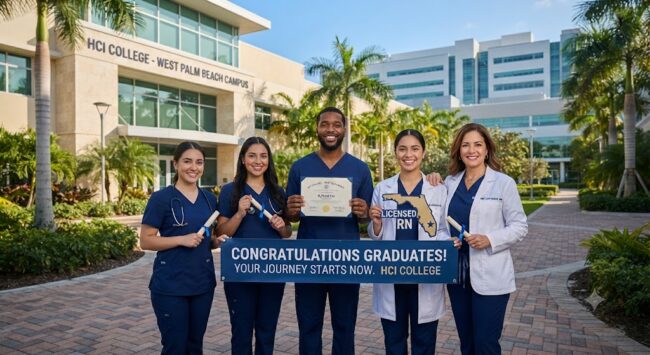
Quick answer: Earning a nursing or healthcare credential in South Florida follows a clear sequence: choose the credential that matches your goals, enroll in an accredited program, complete your classroom and hands-on clinical training, and pass the licensing or certification exam that unlocks the job. Depending on the path you pick, that journey can take anywhere from under a year to a couple of years — and at an accredited school like HCI College, with campuses in West Palm Beach and Fort Lauderdale, financial aid and career placement support are built into the process.
If you’ve been circling the idea of a healthcare career without knowing exactly how the pieces fit together — degree versus diploma, license versus certification, LPN versus RN — this guide connects them. Here’s what it actually takes to go from where you are now to licensed and working.
Why South Florida Is Built for Healthcare Careers
Before we get into mechanics, it’s worth understanding why so many people in this region are making the leap.
South Florida’s healthcare economy is enormous and still growing. Palm Beach, Broward, and Miami-Dade counties together host a dense concentration of hospitals, surgical centers, physician practices, rehabilitation facilities, home-health agencies, and long-term care communities. That infrastructure exists because of demographics: a large, aging population with complex ongoing health needs.
Layer on a nursing shortage that has persisted for years — driven by retirements, burnout, and a pipeline that hasn’t kept pace — and you get the defining feature of this market: employers need people, and they’re willing to compete for them. For someone entering the field, that’s leverage. It shows up as hiring incentives, scheduling flexibility, tuition assistance, and, most importantly, a genuinely short distance between finishing your training and starting your first job.
The catch, of course, is that every one of those opportunities sits on the far side of a credential. So let’s talk about how you get one.
Degree, Diploma, License, Certification: What’s the Difference?
This is where most newcomers get tangled, so let’s untangle it plainly.
A diploma or degree is what a school awards you when you complete its program. A diploma typically comes from a focused, career-oriented program; a degree (like an associate degree) involves broader coursework and takes longer.
A license is what the state grants you, and it’s what legally permits you to practice. In nursing, you earn it by graduating from an approved program and then passing a national exam — the NCLEX. You cannot practice as a nurse on your school credential alone. The school gets you eligible; the state makes you licensed.
A certification is a related but distinct credential, common in allied health roles like medical assisting. It’s typically awarded by a professional body rather than the state, and it signals competence to employers.
Understanding this distinction matters because it explains why accreditation is non-negotiable. In Florida, the Board of Nursing determines whether a program’s graduates are even eligible to sit for the NCLEX. If you graduate from a program that doesn’t qualify, you’ve earned a piece of paper that cannot become a license. That’s the single costliest mistake a healthcare student can make — and it’s entirely avoidable by verifying accreditation up front.
HCI College, for its part, is accredited by the Accrediting Commission of Career Schools and Colleges (ACCSC) and licensed by the Florida Commission for Independent Education, with nursing graduates prepared for NCLEX eligibility.
Mapping the Pathways: Which Credential Is Right for You?
Healthcare isn’t one career — it’s a ladder, and choosing the right rung to start on saves you time, money, and frustration.
The Practical Nursing (LPN) Path
For a great many South Florida career-changers, this is the sweet spot. A Licensed Practical Nurse provides direct, hands-on patient care: taking vital signs, administering medications within their scope, performing wound care, assisting with daily living, and working alongside RNs and physicians.
The appeal is speed and accessibility. Practical Nursing is a diploma-level credential, meaning you don’t need a four-year degree to become a licensed nurse — you need a high school diploma or GED to enroll, and a passing NCLEX-PN score to be licensed. HCI’s program runs 16 months, which means you can go from no healthcare background whatsoever to a licensed, working nurse in well under two years.
That accessibility is why interest in Fort Lauderdale LPN training has surged. And because it’s a diploma program rather than a competitive degree track, many students find they can enroll without the prerequisite coursework and entrance exams that gate RN degree programs. Anyone comparing a Fort Lauderdale LPN training course against longer options is essentially weighing time-to-work against long-term scope — and for people who need to start earning sooner, the math often favors starting here.
Just as importantly, choosing an LPN training school South FL students actually complete matters more than choosing the theoretically most prestigious option. A credential you finish beats a credential you abandon.
The Registered Nursing (RN) Path
An RN operates with a broader scope: developing and managing care plans, performing more complex clinical procedures, supervising LPNs and aides, and often specializing in areas like critical care, pediatrics, or surgery. The trade-off is a longer, more demanding road — typically an associate degree at minimum, plus the NCLEX-RN.
RN degree programs also tend to ask more of applicants on the front end. Expect the possibility of prerequisite coursework in subjects like anatomy and physiology, and in many cases a standardized entrance exam such as the TEAS. Students researching Pre RN nursing classes Fort Lauderdale options are often doing exactly the right thing: building the academic foundation before applying, rather than discovering a gap mid-application.
If your ambition is the widest possible long-term horizon — highest earning ceiling, most specialization options, clearest route into leadership — then identifying the right RN school Fort Lauderdale offers is where to focus your research. Confirm the exact prerequisites and exam expectations early, because satisfying them can add a term or more to your timeline.
The Allied Health Path
Not everyone who wants a healthcare career wants nursing specifically — and that’s fine. Medical assisting is one of the most accessible entry points into the field, blending clinical duties (taking vitals, assisting with exams, drawing blood in some settings) with administrative work (scheduling, records, patient intake).
For people who want to be in a clinical environment quickly, exploring medical assistant training Fort Lauderdale programs offers a shorter runway than nursing. Some students use it as a proving ground — confirming that patient care genuinely suits them — before committing to a nursing program later.
You Don’t Have to Choose Forever
Here’s the thing most people don’t realize until they’re inside the system: these paths connect. An LPN can bridge to RN. A medical assistant can pivot into nursing. The credential you earn first is a foundation, not a ceiling. Many successful nurses entered through the most accessible door available to them at the time, started earning, and built the rest of their career from there.
The Step-by-Step Route to Your License
Regardless of which path you choose, the sequence looks broadly the same. Here’s how to walk it efficiently.
Step 1: Verify Accreditation Before Anything Else
We covered why this matters, so treat it as the gate you pass before spending another minute on a school. Confirm institutional accreditation, confirm state licensing, and confirm that graduates are eligible to sit for the relevant licensing exam through the Florida Board of Nursing. Everything else in this process is wasted effort if this box isn’t checked.
Step 2: Meet the Admission Requirements
Most South Florida programs ask for a familiar set of things: a high school diploma or GED, a completed application and enrollment agreement, valid government-issued identification, and — because you’ll eventually be working with real patients — immunization records, a physical exam, a background check, and a drug screen before clinical rotations begin.
Comfort learning in English is also essential, since instruction and the NCLEX are administered in English.
A word of hard-won advice: start the health and background clearances first. Appointments, lab results, and background reports run on their own timelines, and they are far and away the most common cause of a delayed start. Handle them early and the rest of the process feels easy.
Step 3: Complete Your Classroom and Clinical Training
This is the heart of it. Quality programs pair theory with substantial hands-on practice — first in simulation labs, then in real clinical settings with real patients. Practical nursing coursework typically spans anatomy and physiology, pharmacology and medication administration, medical-surgical nursing, and care across pediatric, obstetric, and geriatric populations.
The clinical component is what transforms knowledge into competence. It’s also what employers care about most: they want graduates who have already been on a floor, handled real situations, and developed judgment under supervision. When evaluating Fort Lauderdale nursing training classes, ask pointed questions about where clinical rotations occur and how many hours you’ll log. That answer tells you a lot about how prepared you’ll be on day one.
Step 4: Pass the NCLEX
The NCLEX is the national licensing exam — NCLEX-PN for practical nurses, NCLEX-RN for registered nurses — and it’s the gateway between graduation and practice. Strong programs build exam readiness into the curriculum rather than treating it as an afterthought, because a school’s NCLEX pass rate is one of the clearest signals of how well it prepares students.
When you’re vetting a Fort Lauderdale school for LPN training, ask directly about NCLEX preparation and outcomes. It’s a fair question, and a good school will answer it without hesitation.
Step 5: Get Licensed and Get Hired
Once you pass, the Florida Board of Nursing issues your license, and you can practice. This is also where career placement support earns its keep — accredited schools that offer graduate placement assistance help you translate a fresh credential into an actual job, which is the entire point of the exercise.
What Nursing School Actually Demands of You
It’s worth being candid here, because unrealistic expectations cause more dropouts than academic inability does.
Nursing programs are intense. You’ll juggle lectures, skills labs, and clinical rotations, often on a schedule that leaves little slack. The material moves fast and builds on itself — fall behind in pharmacology and it compounds. Clinical days can be long and physically demanding, and you’ll be learning to think on your feet in situations where the stakes are real.
None of that should scare you off. It should simply inform how you plan. The students who thrive aren’t necessarily the smartest in the room; they’re the ones who prepared their lives for the program before it started. That means talking to your employer about scheduling in advance, arranging childcare or family support, mapping out reliable transportation to both campus and clinical sites, and building a study routine in the weeks before classes ramp up rather than scrambling once they do.
Many students do work while enrolled, but it takes deliberate planning and honest self-assessment about how many hours you can realistically sustain. Anyone considering LPN nurse training in Fort Lauderdale while holding down a job should have that conversation with an admissions advisor early — a good one will tell you the truth about the time commitment rather than sell you a fantasy.
The other thing worth knowing: the qualities that make someone a strong nurse aren’t purely academic. Empathy matters, because patients are often frightened. Attention to detail matters enormously, because medication doses and charting leave no room for error. Composure under pressure matters, because things move quickly. Physical and emotional stamina matter, because shifts are long and some days are hard. If you naturally care about people and can stay organized under stress, you already have the foundation — training develops the rest.
What About Cost?
Tuition anxiety stops more people than academic difficulty does, and it usually shouldn’t.
Accredited schools offer several routes to make the numbers work. HCI College notes that financial aid is available to those who qualify, alongside scholarships, payment options, and career placement assistance for graduates. To prepare on the financial side, file the FAFSA if you plan to use federal aid, ask directly about institutional scholarships, and investigate employer tuition assistance or veteran and military benefits if they apply to you.
Two practical tips. First, ask for a net-price estimate rather than reacting to a sticker figure — what you actually pay is often meaningfully different. Second, ask what’s included. HCI’s practical nursing program, for instance, supplies required materials and a set of uniforms at no extra cost, which quietly trims the hidden expenses that ambush unprepared budgets.
Where to Train in South Florida
Location matters more than people expect, because clinical rotations, labs, and in-person classes require you to physically be somewhere on a regular schedule. A manageable commute is a real factor in whether you finish.
HCI College operates two South Florida campuses:
West Palm Beach (561) 586-0121 1764 North Congress Ave. West Palm Beach, FL 33409 (Corner of Congress Ave. and Westgate Ave.)
Fort Lauderdale (954) 626-0255 1201 W. Cypress Creek Rd. Suite 101 Fort Lauderdale, FL 33309
The two-campus footprint means students across the region have a reasonable option. Residents in northern Palm Beach County researching Palm Beach Gardens LPN programs often find the West Palm Beach campus is the practical choice, while those closer to Broward gravitate toward Fort Lauderdale. If you’re weighing a school for LPN in Fort Lauderdale, the Cypress Creek Road location puts training within reach of much of the county.
Either way, ask the admissions team where clinical placements typically occur so you can plan the full logistics — not just the drive to class, but the drive to your rotations.
Common Mistakes to Avoid
A handful of missteps derail otherwise capable students. Sidestep these:
- Enrolling somewhere unaccredited. It can void your financial aid and your NCLEX eligibility. Verify first, always.
- Procrastinating on health and background clearances. They take the longest. Start them immediately.
- Choosing the wrong credential for your goals. Know whether you’re aiming at LPN, RN, or allied health before you apply, so you prepare for the right requirements.
- Underestimating the workload. Programs combine classroom hours, labs, and clinicals. Arrange your work and family life before classes start, not after.
- Assuming you can’t afford it without asking. Financial aid, scholarships, and payment plans exist. Ask.
The Bottom Line
Earning a nursing or healthcare credential in South Florida is a genuinely achievable goal, and the sequence is more straightforward than the jargon suggests. Pick the credential that fits your timeline and ambitions. Enroll somewhere accredited. Complete your training — classroom and clinical. Pass your licensing exam. Then step into a field that is actively looking for you.
The LPN route offers the fastest on-ramp into licensed practice. The RN route opens the widest long-term horizon. Allied health roles like medical assisting provide an accessible entry point for those still exploring. And critically, none of these choices locks you in — they connect, and you can keep climbing.
The most useful thing you can do today is talk to an admissions advisor who can map these options against your actual circumstances: your timeline, your budget, your family, your goals. Call the West Palm Beach campus at (561) 586-0121, the Fort Lauderdale campus at (954) 626-0255, or visit www.hci.edu to learn more.
Florida’s demand for healthcare workers isn’t slowing down. The only question left is when you decide to meet it.
About Brian French
Led by a commitment to tech-intelligent curation, Brian French tracks and analyzes breaking business news with Fl Business Newswire. Brian brings an extensive financial background to his analysis, having graduated from the University of South Florida in Finance and serving as a Vice President and Portfolio Manager for Merrill Lynch Private Investors and the Trust Department in St. Petersburg, FL, as well as a Vice President and Trust Investment Officer for SunTrust Bank in Sarasota, FL. His writing blends macroeconomic trends, capital market analysis, corporate strategy, and modern digital insights for a sophisticated look at Florida's business market.