Investment theses come in two varieties. Most are stories about why a particular asset is mispriced today. A few are stories about why a structural force will reshape an asset class over the next decade or longer. The second kind is rarer and typically more durable.
South Florida waterfront real estate, in 2026, fits the second description. The same kind of multi-decade demographic and capital migration that built California’s coastal markets in the 1970s and 1980s is now playing out east, with one critical difference: the supply of true waterfront in South Florida is geographically fixed and getting smaller, not larger, every decade. The buyers showing up are wealthier, more permanent, and more numerous than at any point in the region’s history.
This article makes the case that the long-term opportunity in South Florida waterfront is real, identifies what’s actually driving it, and addresses the risks that could change the story.
The Migration Numbers Are Genuinely Unprecedented
Begin with what the IRS data shows. In 2023 alone, Florida gained $20.65 billion in net adjusted gross income from domestic migration — more than three times the gain of the second-place state (Texas at $5.5 billion) and the largest single-year wealth inflow recorded for any state in modern IRS reporting.
The other side of the ledger is just as striking. California lost $11.9 billion in AGI in the same period; New York lost $9.9 billion. Over the last decade, New York alone has shed approximately $111 billion in net adjusted gross income to interstate migration. The composition matters more than the headline: these are not retirees moving to lower-cost states. The departing households skew significantly higher-income than the populations they’re leaving behind.
Florida now hosts approximately 1.18 million millionaires, the second-largest concentration in the country behind only California. The state is adding an estimated 15,000 net new millionaires per year. While the total wealthy population in California is still larger, the arrows are moving in opposite directions — and the gap is closing.
The geographic concentration of this wealth inside Florida is critical for the waterfront thesis. The Town of Palm Beach has reached an average household income above $350,000 — roughly triple the national average. Palm Beach County overall has the highest millionaire density of any county in the state, with millionaires representing nearly 9.2% of households. Collier County (Naples) sits at 7.9%. Miami-Dade and Broward have lower density figures by household percentage but vastly more total millionaires by raw count.
This is the demographic substrate underneath the waterfront market.
Marc Elkman South Florida Luxury Real Estate:
Marc Elkman Empire Development
Why High-Net-Worth Migration Hits Waterfront Hardest
A general migration of wealthy households into Florida supports the broader luxury real estate market. The waterfront segment specifically benefits more than other luxury subsegments for four interlocking reasons.
Discretionary purchases concentrate at the top. Inland luxury homes serve a wide range of buyers — corporate executives, established professionals, business owners. Trophy waterfront serves a narrower buyer profile that maps almost perfectly onto the high-net-worth migration data. As that buyer pool grows, demand pressure shows up disproportionately in the segment built for it.
Cash dominates the top tier. Most ultra-luxury waterfront sales close in cash. The supporting tier ($3M to $15M) frequently uses jumbo financing, but trophy purchases above $15M routinely don’t involve a mortgage at all. This insulates the very top of the waterfront market from the interest-rate sensitivity that affects the rest of the housing market — and means that capital fleeing high-tax states with appreciated assets is competing for a fixed supply.
Tax planning amplifies real estate decisions. The migration is being driven by tax efficiency, but tax efficiency translates into real estate behavior in a specific way. A California resident selling $1 million in capital gains pays roughly $133,000 in California state taxes. A Florida resident pays $0 in state capital gains tax on the same transaction. For households making nine-figure liquidity events, the savings are large enough to fund a significant share of a waterfront acquisition. The sale of the appreciated asset and the purchase of the Florida home become a coordinated transaction.
Estate planning compounds the effect. Florida has no state estate or inheritance tax. The federal estate tax exemption was scheduled to step down materially after 2025 under the 2017 tax law sunset, and even after the 2025 federal tax legislation, estate planning urgency for high-net-worth families has not gone away. Real estate held in Florida-domiciled structures, owned by Florida-domiciled individuals, becomes part of a multi-generational wealth-preservation strategy. That logic specifically rewards trophy assets that can be held across generations rather than turned over.
The combined effect is that waterfront benefits from the migration in a more concentrated way than the broader market does — even before considering supply constraints.
The Supply Side: A Shrinking Asset, Not an Expanding One
Coastal real estate everywhere is supply-constrained, but South Florida’s specific geography makes the constraint unusually severe.
True waterfront in South Florida — meaning direct frontage on the Atlantic, the Intracoastal, navigable canals with ocean access, or major bays — exists on a fixed inventory of parcels that were largely platted between the 1920s and the 1970s. No new Indian Creek Village is being created. No new Star Island is being dredged. No new Manalapan barrier-island parcels are being added to the rolls. The town of Palm Beach maintains zoning, planning, and architectural review controls specifically designed to prevent supply expansion.
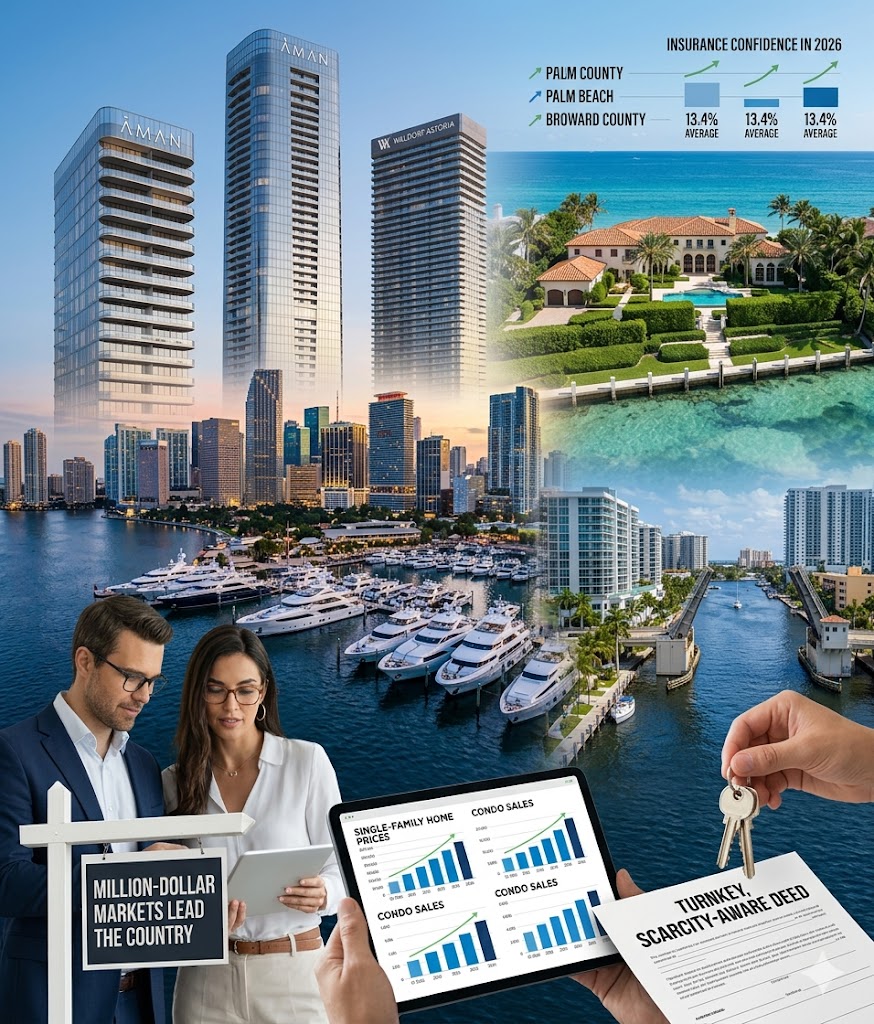
The total number of single-family direct-waterfront parcels in the tri-county region is, in fact, slowly declining over time, not increasing. Sea-level concerns have led to occasional parcel consolidation. Hurricane events have removed some structures permanently. Conversion of older waterfront single-family parcels to multi-unit condominium development reduces single-family supply even as it adds total units. New condominium development at the absolute top of the market (the Surf Club, Mr. C, Aman, Waldorf Astoria, and the wave of branded residences) adds units in specific buildings but doesn’t create new shoreline.
The demand-supply asymmetry is the heart of the long-term thesis. Demand is growing structurally; supply is fixed or shrinking; and the buyers who do show up have extraordinary purchasing power.
The Capital That’s Already Voted
If the macro data points are abstract, the specific capital flows of the last several years are concrete.
Citadel’s relocation of its global headquarters from Chicago to Miami, announced in 2022, was the first major signal. Ken Griffin’s personal real estate purchases — including approximately 4.2 acres in Brickell that have been the subject of ongoing development planning — anchored Miami as the new Wall Street South. Citadel was followed by a sustained migration of hedge funds, private equity firms, family offices, and increasingly technology firms.
The largest individual transactions tell the same story. Larry Page reportedly assembled approximately $173 million in Miami real estate. Sergey Brin has worked through California LLC dissolutions consistent with a domicile change. Peter Thiel opened an office in Wynwood. Jeff Bezos completed multiple large purchases in Indian Creek Village. The Surf Club’s Seaway North project — 10 ultra-luxury units in Surfside, average sale price around $38.6 million — was approaching a $400 million sellout in early 2026.
The November 2025 election of New York City’s new mayor on a platform that included income tax surcharges for high earners produced a measurable acceleration in inquiries from Manhattan and Brooklyn beginning in early 2026. South Florida developers reported substantial contract volumes from New York buyers in the weeks immediately following the election. International capital from Latin America (Brazil, Argentina, Mexico, Colombia) and Europe continues to fund roughly half of new construction sales in South Florida.
This is what a structural shift looks like in real time. None of these moves are speculative bets on near-term price movement. They are positioning decisions for a multi-decade thesis.
The Tax Math Underwriting the Thesis
The arithmetic is simple enough to be worth working through explicitly.
A household earning $5 million per year in New York City pays a combined state and city income tax rate approaching 14.8%. The same income in Florida is taxed at 0% by the state. The annual difference is approximately $740,000 — every year, indefinitely.
Capitalize that difference at conservative discount rates and the present value over a 20-year horizon runs into eight figures. For a household at this income level, the rational allocation of that capitalized tax savings is meaningful real estate, both because it serves the lifestyle that supports the income generation and because it anchors the domicile claim that secures the savings.
Capital gains transactions amplify the math further. A founder selling a privately held company for $200 million in a state with a 13.3% top capital gains rate pays $26.6 million in state tax. The same transaction completed after Florida domicile is established pays zero state tax. The savings, in many cases, exceed the entire purchase price of the trophy waterfront home that anchors the new domicile.
Florida’s homestead exemption and the Save Our Homes 3%-or-CPI annual assessment cap (limiting annual increases in assessed value on homesteaded primary residences) layer additional ownership-cost benefits that compound across long holds. The state has no estate or inheritance tax, no tax on Social Security or retirement income, and a regulatory environment broadly designed to retain rather than tax mobile wealth.
For households whose marginal decision is “where to live,” the financial weight on the Florida side of the scale has become large and is getting larger.
What Returns Could Look Like — and the Honest Caveats
West Palm Beach luxury home prices appreciated approximately 187% over the 2015–2025 decade per Redfin’s analysis — the fastest decade-long appreciation among major U.S. luxury submarkets. South Florida’s tri-county region recorded 361 closings above $10 million in 2025, the second-highest year in history behind only the 2021 anomaly. Q1 2026 luxury single-family transactions rose 19.6% in Miami-Dade, 21.1% in Palm Beach, and 8.9% in Broward.
The honest framing on returns: nobody should underwrite a luxury waterfront purchase as a financial investment expected to produce predictable cash returns. The asset class doesn’t work that way. Carrying costs are substantial. Liquidity is limited. Insurance, maintenance, and tax exposure have to be funded continuously. The asset is not income-producing in most ownership configurations.
What waterfront does well is preserve and compound capital across long holds, while serving as the tangible anchor for a domicile and lifestyle that produce far larger savings elsewhere in the financial picture. The right way to think about a $20 million Palm Beach waterfront purchase is not “what will this be worth in 2036?” but “what does owning and occupying this asset protect across the next twenty years of income, capital gains, and estate planning decisions?”
That second question often produces a return profile that materially exceeds what any pure financial investment of similar size would generate.
The Risks That Could Change the Story
A serious investment thesis names what could go wrong.
Climate exposure is real. Sea-level rise projections, hurricane intensity trends, king tide flooding, and saltwater intrusion all affect waterfront more directly than any other real estate segment. Florida insurance markets have improved significantly in 2026, but a major storm season can re-tighten markets quickly. Buyers underwriting waterfront for multi-decade holds have to take elevation, seawall integrity, structural resilience, and insurance market access seriously. This is the single largest risk factor in the thesis.
Insurance market volatility persists. The 2026 entry of 17 new homeowners carriers and the average 13.4% rate decreases are genuine improvements. They are not permanent. A Florida insurance market that requires constant legislative attention and federal backstop programs is structurally different from one that operates without them. Anyone modeling 30-year ownership costs needs to model insurance volatility as a real factor.
Federal tax policy could change. The current advantages of Florida domicile are large because the gap between Florida and California or New York is large. Federal tax changes that reduced state tax differentials — for example, restoration of unlimited state and local tax (SALT) deductibility — would compress the migration math. The 2025 federal tax legislation extended many of the 2017 tax law provisions, but federal tax policy is subject to political change.
Migration could moderate. The pandemic-era acceleration was unusual. The continued migration in 2026 reflects sustained but more measured rates than the 2020–2022 peak. Anyone underwriting future waterfront returns based on the assumption of pandemic-era migration rates is pricing in conditions that have already normalized.
State and local response. As more wealth concentrates in specific Florida counties, local property tax rates, special assessments, and infrastructure funding mechanisms could shift. The political balance in some specific waterfront municipalities (Palm Beach, Indian Creek Village, parts of Miami Beach) is structurally protective of existing owners; in others, it is less predictable over multi-decade horizons.
Asset-specific issues. Individual waterfront properties carry their own risks — title complications on barrier islands, condominium reserve adequacy in older buildings, dock and seawall obligations, environmental issues. The macro thesis is sound for the right property; it does not compensate for the wrong property.
What the Thesis Implies for Buyers
For households positioned to participate, several conclusions follow:
Domicile decisions are real estate decisions. The optimal sequencing of a high-net-worth move to Florida treats the home purchase, the tax domicile change, the estate planning structure, and the timing of any major liquidity event as a single coordinated process. This requires professional support that can integrate across disciplines — typically a Florida real estate attorney, a CPA familiar with multistate residency issues, and a financial planner working in concert.
Trophy assets in scarcity-protected locations are different. The thesis is strongest where supply is most constrained. Palm Beach Island, Indian Creek Village, Star Island, Manalapan, the Surfside corridor, certain canals in Las Olas Isles, and a small number of comparable enclaves benefit from scarcity that is policy-enforced as well as geography-enforced. The same thesis is meaningfully weaker for more abundant waterfront product in less protected locations.
Trophy condo product is participating in the same dynamic. Branded residences from Aman, Waldorf Astoria, the Surf Club, and similar projects are functioning as substitutes for trophy single-family at the very top of the market. For buyers who prefer turnkey, lock-and-leave, service-rich ownership, they offer the migration thesis in condominium form — without the seawall obligations and personal-residence diligence that single-family requires.
Time horizon matters. This is a long-duration thesis. Buyers underwriting five-year holds are mostly trading on near-term market dynamics, not the structural migration story. The argument for waterfront strengthens over 10-, 15-, and 20-year horizons, where the supply constraint and the demographic substrate compound.
Diligence still matters. The macro thesis does not exempt any individual transaction from the full diligence work — title, structural, marine engineering on seawalls and docks, insurance binding, and (for condos) post-Surfside reserve and milestone review. The right macro story does not save you from the wrong specific asset.
A Final Frame
Investment theses built on demographic and capital-flow arguments work when the forces driving them are durable, the supply response is constrained, and the alternative options for the affected capital are limited. The South Florida waterfront thesis satisfies all three conditions.
High-net-worth migration to Florida is being driven by tax structures that are unlikely to reverse meaningfully in the next decade. The supply of true waterfront in South Florida is geographically fixed. The capital being deployed is largely cash, largely permanent, and largely concentrated on a small set of trophy submarkets that are themselves protected by zoning, governance, and physical scarcity.
That doesn’t make every waterfront purchase a good purchase. The asset class is not exempt from climate risk, insurance volatility, or asset-specific diligence failures. The wrong property in the right thesis can still lose money. But for households with the means to participate, the multi-decade structural picture is unusually clear: more demand, less supply, more capital, more permanent presence.
For long-term holders prepared to do the work, that’s the kind of setup that historically produces the best results in real estate. Not because it’s a fast trade — it isn’t — but because the underlying forces compound in one direction over time, and they are doing so now.
The window for participating in the early phase of a multi-decade migration is, by definition, finite. South Florida’s appears to still be open in 2026.
Disclaimer (repeated): This is editorial analysis based on publicly reported data and is not investment, tax, legal, or real estate advice. Statistics, forecasts, market data, and demographic trends cited reflect the author’s best understanding at time of writing and are subject to change. References to specific transactions, individuals, developers, locations, and projects are illustrative and do not constitute endorsement, solicitation, or guarantee of any outcome. Real estate investment carries substantial risks including but not limited to market risk, liquidity risk, interest rate risk, climate and weather exposure, regulatory change, insurance availability, and asset-specific structural and title issues. Past performance does not predict future results. Tax, estate, and domicile planning involves complex multistate and federal considerations that depend on individual facts and circumstances. Anyone considering a Florida real estate purchase or domicile change should engage qualified Florida-licensed real estate, legal, tax, and financial professionals familiar with their specific situation before making any decision.
About Brian French
Led by a commitment to tech-intelligent curation, Brian French tracks and analyzes breaking business news with Fl Business Newswire. Brian brings an extensive financial background to his analysis, having graduated from the University of South Florida in Finance and serving as a Vice President and Portfolio Manager for Merrill Lynch Private Investors and the Trust Department in St. Petersburg, FL, as well as a Vice President and Trust Investment Officer for SunTrust Bank in Sarasota, FL. His writing blends macroeconomic trends, capital market analysis, corporate strategy, and modern digital insights for a sophisticated look at Florida's business market.