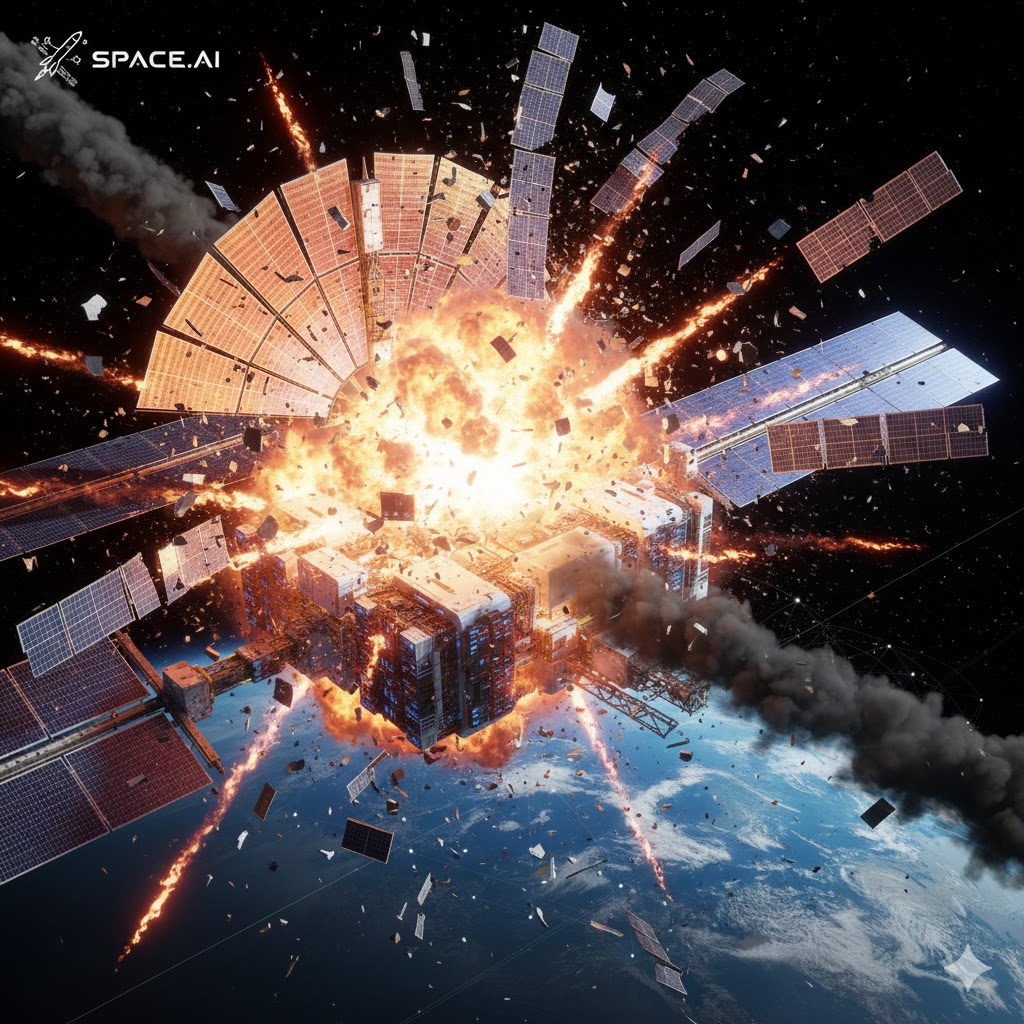
A merger between SpaceX and xAI would create a corporate entity with a theoretical market capitalization potentially exceeding $500 billion to $1 trillion, based on their individual private valuations. However, the financial architecture of such a “space-intelligence” conglomerate would face a severe disconnect between its valuation and its fundamental cash flows.
Here is a breakdown of why this structure would be precarious and why space-based data centers represent a multi-hundred-billion-dollar capital gamble.
The Valuation vs. Cash Flow Paradox
Currently, SpaceX is valued for its dominant launch capability and the future promise of Starlink, while xAI is valued on the “potential energy” of its Grok models and its access to massive compute clusters.
- Valuation Driven by Scarcity and Narrative: The market cap would be supported by “scarcity value”—investors wanting exposure to the two most frontier sectors (Space and AI). However, market cap is a reflection of equity value, not liquidity.
- The “Cash Burn” Problem: Both entities are capital-intensive. SpaceX must constantly reinvest every dollar of Starlink profit back into Starship development. xAI requires billions for H100/B200 GPU clusters and electricity.
- Lack of Yield: A combined merger would likely produce zero dividends and thin margins for years. When a company has a massive market cap but little free cash flow, it becomes hyper-sensitive to interest rates. If the cost of debt rises, the company cannot easily “service” the capital needed for expansion without further diluting shareholders.
The Hundreds of Billions in Capital for Space Data Centers
Moving data centers from terrestrial locations to orbit is not a marginal cost increase; it is an exponential one. To build a space-based compute infrastructure that rivals a terrestrial “Gigafactory,” the capital requirements would be staggering:
- The Thermal Barrier: In space, you cannot use fans or liquid cooling in the traditional sense because there is no air to carry heat away. You must use massive radiator arrays. Building a radiator system capable of cooling 100,000 GPUs would require structural engineering on the scale of several International Space Stations.
- Energy Capture: A large-scale AI data center requires megawatts, eventually gigawatts, of power. To get this in space, you need square miles of high-efficiency solar arrays. The cost of manufacturing and launching this surface area—even with Starship’s lower costs—reaches the hundreds of billions quickly.
- Redundancy and Hardening: Space hardware must be “radiation-hardened.” Standard NVIDIA chips would likely suffer from high error rates or “bit flips” due to cosmic rays. Developing custom, space-grade AI silicon or massive shielding adds another layer of extreme cost.
The Interest Gap: “Few Things Paying the Interest”
The most significant financial risk is the cost of carry. If a combined SpaceX/xAI entity borrows $200 billion to build orbital compute, and the interest rate is 5%, they must find $10 billion a year just to pay the interest on that debt.
- Delayed Monetization: The “revenue” from space-based AI (latency-free global intelligence, orbital edge computing, or sovereign data havens) is speculative. If the data center takes 10 years to become fully operational, the compound interest alone could dwarf the original principal.
- Low-Margin Competition: While space data centers offer “sovereignty” (data outside national jurisdictions), they must compete with terrestrial data centers that have access to cheap hydro-power and easy maintenance. If terrestrial AI services remain “good enough” and significantly cheaper, the space data center becomes a “stranded asset”—a massive piece of hardware with no way to pay off the debt used to build it.
More Florida News and Press Releases:
• Uncovering Florida’s $34B Insurance Crisis: Ryan Serhant’s Real Estate Revelations
• Can news website links help increase Google search rankings?
• Benefits of Social Media Marketing for your Florida business
• Business Marketing with Florida News Posting and Linking
• The Walt Disney World Story in Florida
A SpaceX/xAI merger would be a “Balance Sheet Bet” on the far future. It would rely on the “Permanent Capital” of visionary investors willing to ignore traditional metrics like Price-to-Earnings (P/E) or Free Cash Flow. However, the physical reality of space—specifically the need for massive radiators and solar collectors—demands a level of capital expenditure that could crush any company that does not find a “killer app” for orbital intelligence that can justify the interest payments on hundreds of billions of dollars.