By Brian French | April 9, 2026
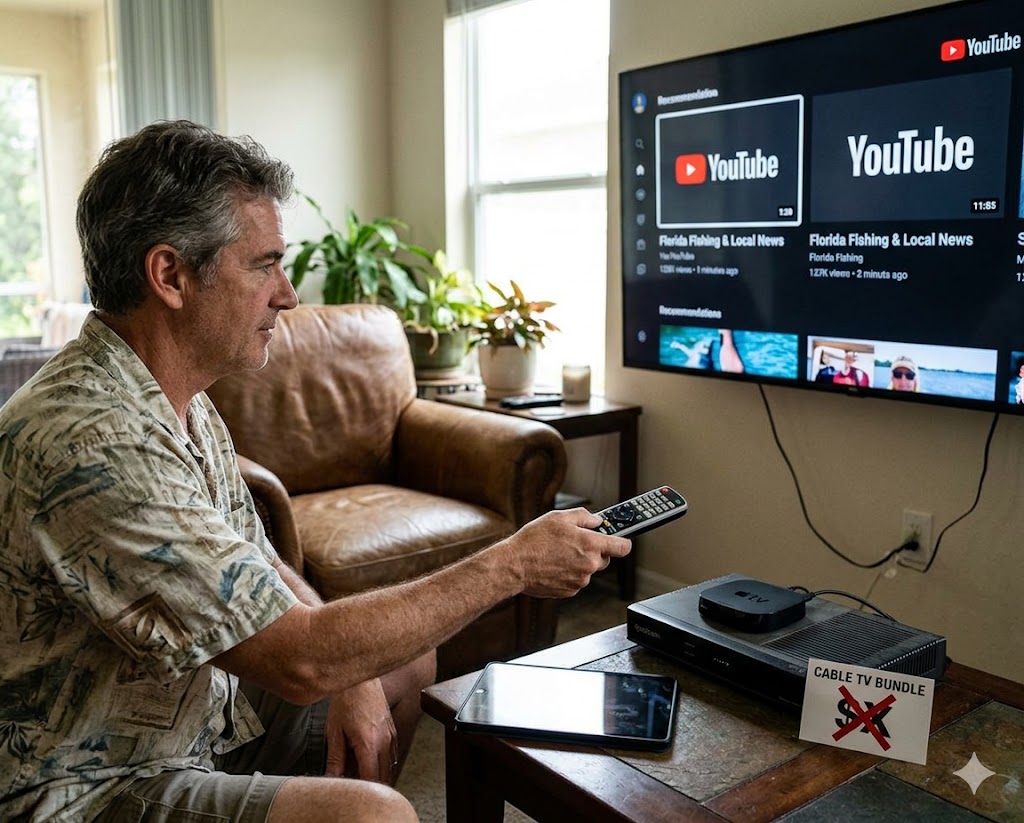
Cord-cutting is accelerating across the state, and Facebook and YouTube are doing more damage to traditional television than any streaming service ever did.
The numbers are not subtle. Florida’s cable television industry is losing customers at a pace that would have seemed unthinkable a decade ago, and the companies that built their businesses around monthly subscription bundles, local news monopolies, and appointment viewing are scrambling to find a response. Some are adapting. Many are not moving fast enough.
The conventional story about cable’s decline focuses on Netflix, Disney+, and the streaming wars. That story is real but incomplete. The deeper disruption — the one that is quietly hollowing out cable’s remaining audience — is coming from platforms that don’t charge a subscription fee, don’t require a smart TV, and fit in your pocket. Facebook and YouTube are not just competing with cable television in Florida. They are replacing it, one scroll at a time.
The Cord-Cutting Numbers Tell a Harsh Story
Florida has consistently ranked among the states with the fastest rates of cable subscription decline. The reasons are structural. The state has a large and growing population of younger residents — particularly in South Florida, Orlando, and Tampa — who never formed the cable habit in the first place. It has a massive retiree population that, contrary to the stereotype, has proven far more willing to abandon cable than the industry predicted. And it has millions of cost-conscious households for whom a $150-a-month cable bundle represents a genuine financial burden.
Major providers serving Florida — including Comcast Xfinity, Spectrum, and DirecTV — have each reported sustained subscriber losses over recent years. The declines have accelerated rather than stabilized, and the industry’s response of raising prices on remaining subscribers has created a cycle that drives even more customers toward the exit.
For the first time in the history of the medium, traditional pay television now reaches fewer than half of American households. Florida is tracking at or below that national average, and the trajectory points in only one direction.
“Florida’s cable companies spent years raising prices on a shrinking customer base and calling it a business strategy. The bill for that decision is now coming due.”
YouTube Has Become Florida’s New Local Television
Walk into a barbershop in Liberty City, a Cuban restaurant in Hialeah, or a fishing bait shop on the Gulf Coast, and there is a reasonable chance the screen on the wall is running YouTube rather than cable. That shift — quiet, unannounced, and enormously consequential — represents one of the most significant behavioral changes in how Floridians consume media.
YouTube’s dominance in Florida is not just about entertainment. The platform has become the default destination for local information, community news, weather updates, sports highlights, political commentary, and the kind of human-interest storytelling that local television stations once owned exclusively. Florida-based YouTube creators have built audiences in the hundreds of thousands — sometimes millions — by covering topics that local cable news either ignores or handles superficially.
The economics are brutal for cable. YouTube is free. It runs on any device. It does not require an installation appointment, a two-year contract, or a cable box that costs $12 a month to rent. For a family in Kissimmee or a retiree in Port Charlotte weighing their monthly expenses, the math is not complicated.
YouTube’s advertising model has also evolved in ways that directly threaten cable’s core revenue. Local and national advertisers who once had no alternative to buying cable spots can now target Florida audiences with precision — by zip code, age, interest, and behavior — through YouTube’s platform at a fraction of the cost. The advertising dollars that sustained cable’s ecosystem are following the eyeballs out the door.
Facebook: The Platform That Captured Florida’s Older Viewers
The cable industry’s last reliable demographic was supposed to be older Floridians — the retirees and snowbirds who grew up with television as the center of household entertainment and who, the thinking went, would hold onto their cable subscriptions longest. Facebook quietly dismantled that assumption.
Florida has one of the largest concentrations of Facebook users over the age of 55 in the country. The platform’s video feed — a feature that has grown dramatically in both volume and watch time over the past several years — now delivers hours of daily video content to millions of older Floridians who might otherwise have been watching cable news, daytime programming, or local broadcasts. Facebook Live has become a genuine competitor to local television for everything from city commission meetings to high school football games to hurricane coverage.
The political content ecosystem on Facebook has been particularly damaging to cable news specifically. Millions of Florida conservatives and liberals alike now get their daily news and opinion diet entirely through Facebook feeds curated by friends, family, and pages they have chosen to follow — bypassing cable news networks entirely. The emotional engagement that cable news spent decades engineering — the urgency, the conflict, the personalities — turns out to be something Facebook replicates and amplifies at no cost to the viewer.
Facebook’s Marketplace and community groups have also stolen something less obvious from local cable: the hyperlocal information function. Neighborhood groups across Florida’s counties have become the place where residents learn about road closures, storm damage, missing pets, local business openings, and community events — content that local cable access channels and regional news broadcasts once had to themselves.
“Facebook didn’t set out to destroy cable television in Florida. It just built something more useful, more personal, and more addictive — and the audience made its choice.”
What Cable Still Does Well — For Now
It would be premature to write cable’s obituary entirely. The industry retains real advantages in Florida that the social media platforms cannot yet fully replicate.
Live sports remain cable’s most powerful retention tool. Florida is one of the most sports-obsessed states in the country, with professional franchises in every major league and a college football culture that borders on religion. The rights agreements that keep NFL, NBA, MLB, and NHL games behind pay-television walls have been cable’s most effective defense against cord-cutting. As long as a Dolphins game, a Heat playoff run, or a Gators matchup requires a cable subscription or a cable-affiliated streaming package to watch legally, a significant segment of Florida’s population will keep paying.
Local news, despite its struggles, still provides something that YouTube and Facebook cannot fully replace — staffed newsrooms with reporters in the field during hurricanes, court proceedings, and breaking emergencies. Florida’s active weather season gives local television a recurring moment of genuine necessity that no algorithm-curated social media feed has matched. When a major storm is bearing down on Tampa Bay or the Keys, a significant portion of residents who cancelled their cable subscriptions find themselves turning the service back on temporarily.
Broadband internet, ironically, has become cable companies’ lifeline. Comcast and Spectrum may be losing video subscribers in Florida at an accelerating pace, but they are gaining or retaining internet customers — many of whom need that internet connection specifically to access the YouTube and Facebook content that replaced their cable television. The companies have been deliberately repositioning themselves as internet providers that happen to offer video, rather than the reverse. It is an uncomfortable pivot, but it is keeping the balance sheets from complete collapse.
The Local News Crisis Hidden Inside the Cable Decline
The conversation about cable’s decline in Florida has a consequence that rarely gets discussed in the cord-cutting coverage: what happens to local journalism when the economic model that funded it collapses.
Florida’s local television stations — the network affiliates in Tampa, Miami, Orlando, Jacksonville, and West Palm Beach — built their newsrooms on advertising revenue tied directly to cable distribution. As cable subscribers leave and advertising dollars migrate to digital platforms, the budgets available for investigative reporting, statehouse coverage, and community journalism shrink accordingly. Several Florida markets have already seen station consolidations, layoff rounds, and reductions in original local programming.
YouTube and Facebook generate enormous revenue — but almost none of it flows back into the local journalism infrastructure that communities depend on for accountability reporting. The platforms distribute content created by others and capture the advertising value of that audience. The creators, including former cable news professionals who have migrated to YouTube channels and Facebook pages, capture some income through platform monetization. The public, however, gets a thinner version of the local news ecosystem that cable, for all its faults, helped sustain.
Where This Is All Heading
The cable television business in Florida is not dying overnight. It is declining steadily, and the decline is structural rather than cyclical — meaning no price promotion, no bundle repackaging, and no new channel lineup is going to reverse it.
The audience that cable built over fifty years in Florida has not disappeared. It has redistributed itself across YouTube, Facebook, Netflix, and a dozen other platforms that offer more choice, more convenience, and in most cases, a lower price. The living rooms are still full. The screens are still on. The viewers are just no longer watching what the cable companies are selling.
For Florida’s cable industry, the honest question is no longer whether decline can be stopped. It is how gracefully the transition can be managed — and how much of the local media infrastructure that cable once supported can survive the journey to whatever comes next.
This article is an independent editorial overview based on publicly available industry data and consumer trends. Figures reflect general trends and should not be taken as precise current measurements.