By Brian French | March 4, 2026
The secret beneath the mountains · American technology · Materials science
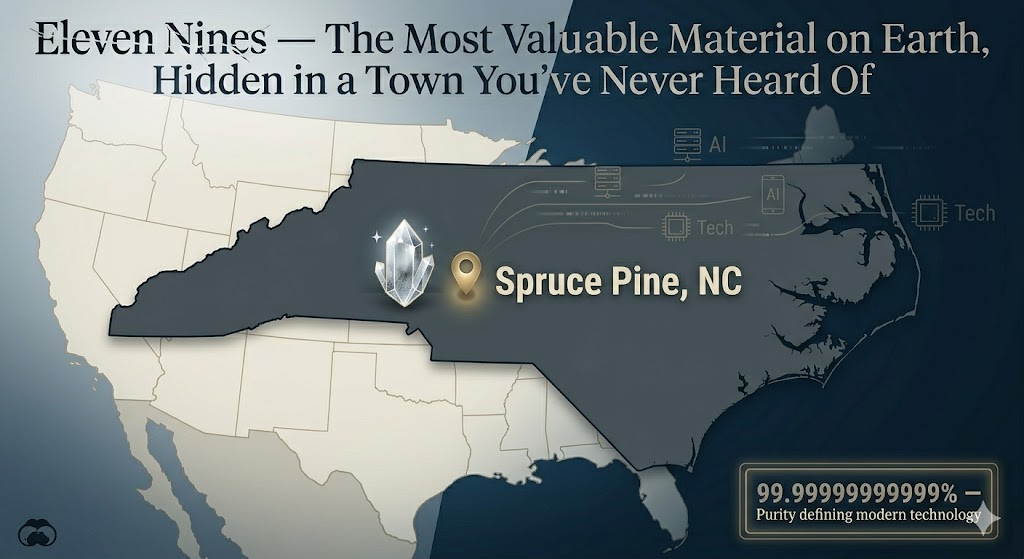
Eleven Nines — The Most Valuable Material on Earth, Hidden in a Town You’ve Never Heard Of
Somewhere in the Blue Ridge Mountains of North Carolina, down a two-lane road that doesn’t appear on most maps, sits the single most important industrial site on the planet. Without it, your phone goes dark. The AI goes silent. The satellites drift blind. Everything stops.
There is a number that the technology industry whispers like a prayer.
Not a stock price. Not a market cap. Not the petaflops of some supercomputer or the nanometers of a chip node. Those numbers come and go. They get beaten by the next quarter, the next generation, the next breakthrough.
This number is different. This number is a standard of purity so extreme, so almost physically impossible to achieve, that it defines the boundary between the world we live in and a world without advanced technology at all. The number is this:
99.99999999999%
Eleven nines. That is the purity of the silicon that makes the chips in your phone, your laptop, your car, your hospital, your military’s guidance systems. Eleven nines pure. For every trillion atoms in the material, fewer than ten are anything other than silicon. In the entire history of human industry, no one has ever needed to make anything cleaner.
And the story of how that silicon comes to exist — the secret hiding at the very bottom of the supply chain, the thing that makes eleven nines even possible — begins in a place you have almost certainly never heard of.
The first clue
A Road With No Name
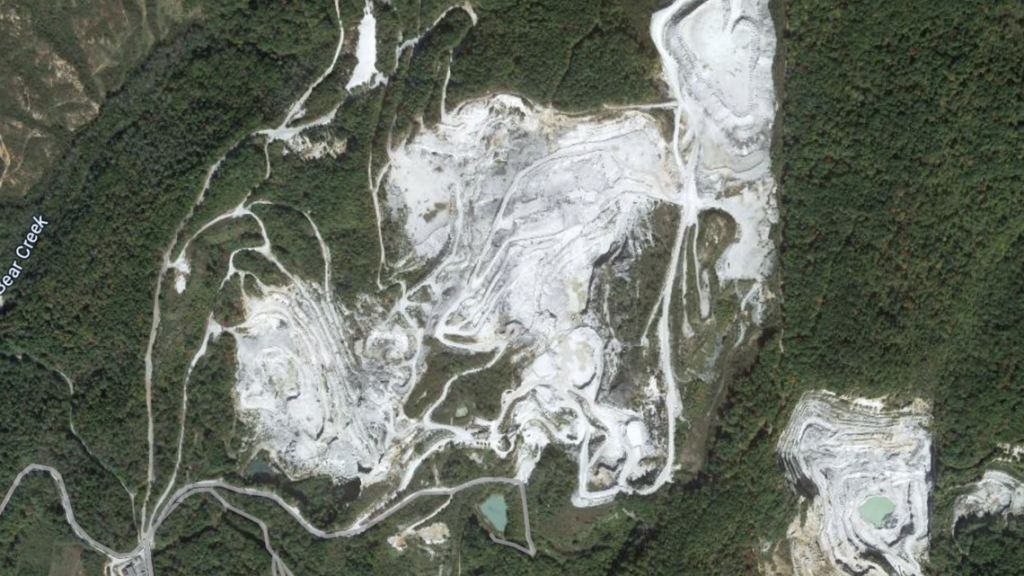
Pull up a satellite map of western North Carolina. Find the Blue Ridge Mountains. Look for the town of Spruce Pine — population 2,000, no traffic lights worth mentioning, the kind of place where people still wave at strangers from their porches. Now find Fish Hatchery Road.
That road, according to Wharton professor Ethan Mollick, is where the modern economy rests.
Not Silicon Valley. Not Taipei. Not the gleaming fab halls of TSMC or the research campuses of MIT. A two-lane rural highway in Mitchell County, North Carolina, flanked by hardwood trees and running toward a mountain that has been quietly holding one of civilization’s most jealously guarded secrets for 380 million years.
The secret in plain sight
Two mining operations sit at the end of Fish Hatchery Road. Most locals know they exist. Almost none know what they supply. The companies that buy from them — the most powerful technology corporations on Earth — prefer it that way. The high-purity quartz industry is, by design, one of the most secretive supply chains in the world.
The second clue
A Collision That Took 50 Million Years
To understand why this particular mountain holds what it holds, you have to go back to a time before there were eyes to see it.
380 million years ago, the supercontinent of Gondwana — ancient Africa — was drifting toward what would become North America. The two land masses met in slow catastrophic collision over tens of millions of years, crumpling the crust upward into mountains that once stood as tall as the Himalayas. The Appalachians, now worn low with age, are the eroded stumps of that ancient cataclysm.
Deep underground, where the collision was generating unimaginable heat and pressure, something was happening that would not reveal its importance for hundreds of millions of years. Rock was melting. Mineral-rich liquid was forming and moving through cracks in the proto-continent. And then, slowly, it began to cool and crystallize.
Here is the detail that changes everything: there was almost no water present.
Water sounds innocent. In geology, it is the enemy of purity. Water carries dissolved minerals — iron, titanium, aluminum, boron — and deposits them into whatever crystal it touches. Every quartz deposit on Earth that formed in the presence of water is contaminated at the molecular level, permanently and irreversibly. The contaminants are locked inside the crystal structure itself, invisible to the eye, impossible to remove no matter how sophisticated your chemistry.
But in this one valley, in this one collision zone, the chemistry was dry. And so the quartz that crystallized was extraordinary. It was, as one geologist who has spent decades searching the world for its equal put it, “the purest natural quartz ever found on Earth.”
“It is rare, unheard of almost, for a single site to control the global supply of a crucial material. Yet if you want high-purity quartz — the kind you need to make those crucibles without which you can’t make silicon wafers — it has to come from Spruce Pine.”— Ed Conway, Material World (2023)
The third clue
What Makes a Chip Possible
To understand why this ancient quartz matters so desperately to the modern world, you need to follow a single silicon atom on its journey from mountain to microchip. It is a journey through fire, acid, and near-impossible standards of cleanliness.
It begins with the crucible.
In every silicon wafer factory on Earth — in Taiwan, South Korea, Japan, Germany, Arizona — there are furnaces running at 1,425 degrees Celsius. That is hot enough to melt silicon into a liquid. Inside each furnace sits a bowl, roughly the size of a large cooking pot, made of fused quartz glass. Into this bowl, engineers load lumps of polysilicon — silicon already purified to somewhere around nine or ten nines. Then they dip a tiny “seed crystal” into the molten silicon and slowly, delicately, rotate it and pull it upward. Atom by atom, the silicon assembles itself around the seed in perfect crystalline order, growing into a cylinder — an ingot — that can be a foot wide and over a meter tall. This ingot is then sliced into wafers thinner than a human hair. Those wafers are the substrates on which every chip you have ever used was built.
This process is called the Czochralski method, named after a Polish chemist who discovered it accidentally in 1916 by dipping his pen into molten tin. It is the foundation of the entire semiconductor industry.
And here is the critical detail that brings us back to North Carolina: the crucible cannot contaminate the silicon. Not even by a single atom in a trillion. If the bowl leaches even trace amounts of iron, or aluminum, or titanium into the melt, the resulting crystal is ruined — useless for making chips. So the crucible must be made from the purest quartz on Earth.
There is only one place on Earth that reliably produces quartz pure enough for this purpose at industrial scale. One place. One valley. One mountain.
| 70–90% Of all ultra-pure quartz used worldwide comes from Spruce Pine | 11 nines Maximum achievable silicon purity — 99.99999999999% | 400 hrs A single quartz crucible’s lifespan before it must be replaced | 30% Of silicon ingot production cost is the quartz crucible alone |
The fourth clue
The Open Crystal
There is one more layer to this mystery that separates Spruce Pine quartz from every imitation and every competitor — and it is invisible to the naked eye.
Most quartz, even relatively pure quartz, has what scientists call a closed crystalline structure. The atoms are packed tightly together. When contaminant molecules attach themselves to the crystal during formation — and they almost always do — they become permanently embedded. No acid can reach them. No heat treatment can dislodge them. They are locked in, forever.
Spruce Pine quartz has an open crystalline structure. The atoms are arranged with enough space between them that hydrofluoric acid — one of the most aggressive chemicals known to science — can be injected directly into the crystal lattice. The acid finds the traces of iron and feldspar hiding inside the crystal and dissolves them, pulling them out through channels too small to see. It is molecular-level surgery, performed on an industrial scale.
Engineers then push the process further still: chlorine gas at extreme temperatures, followed by more acid treatment, followed by exacting quality analysis at the parts-per-billion level. The final product — marketed under the trade name IOTA — is a fine white powder that is, by any reasonable standard, one of the most precisely engineered materials in the history of human industry.
This is what the world’s chip factories are waiting for. This is what the AI revolution runs on. This is what comes out of that mountain in Mitchell County, North Carolina.
The fifth clue
The Day the World Nearly Found Out
For most of its existence, Spruce Pine kept its secret well. The companies that mined there were discreet. The companies that bought from them were even more discreet. The supply chain operated in near-total obscurity, known mainly to geologists, materials scientists, and a small circle of semiconductor executives who understood exactly how fragile their world was.
Then, on September 26, 2024, Hurricane Helene made landfall.
The storm dumped more than 24 inches of rain in 24 hours onto the Blue Ridge Mountains. It flooded mines, washed out roads, cut power to the entire region. Both Sibelco and The Quartz Corp — the two companies operating the Spruce Pine mines — shut down operations. The town was devastated. More than 200 people died across six states.
Within days, alarm signals began propagating through the global semiconductor supply chain. Analysts at investment banks ran the numbers. Industry watchers reached for emergency contacts. The question being asked in boardrooms from Seoul to Phoenix: if the Spruce Pine mines stayed down for three months or more, would chip production begin to slow? The answer, according to industry insiders, was almost certainly yes. The world had come within weeks of discovering, in the most painful way imaginable, just how much of its technological civilization rested on a single point of failure in the Appalachian Mountains.
The mines came back online. Stockpiles held. The crisis passed quietly, barely noticed by the general public. The secret kept itself one more time.
The revelation
America’s Invisible Crown Jewel
Here is what makes this story not just a mystery but a genuinely astonishing one: the most critical natural resource in the global technology supply chain is American. It is sitting in a valley in North Carolina that has been there, unchanged, for 380 million years. It was there when Columbus landed. It was there when Edison filed his first patents — and in fact Edison himself used Spruce Pine mica to insulate his electrical inventions in 1879, making this mountain’s contribution to technology older than the lightbulb.
The world’s AI boom — the data centers multiplying across the American landscape, the chips designed in California and manufactured in Taiwan, the models that answer your questions and drive your car and read your X-rays — all of it traces back, ultimately, to quartz from two mines on a rural highway in a town most Americans couldn’t find on a map.
And the deposit is not running out. Geological surveys suggest the mine has more than 100 years of reserves remaining. Sibelco, the company operating the largest mine, has committed $700 million to expand production capacity. North Carolina’s legislature, awakening to what it has been sitting on, passed laws in 2024 banning Chinese or Russian ownership of quartz mines in the state. A secret, once discovered, requires protection.
“An estimated three-quarters of Spruce Pine has a direct connection to the mines — through a job, a job that relies on the mines, or a family member who works there.”— Spruce Pine town council member, 2024
Saudi Arabia understood decades ago that it was sitting on the resource that powered the 20th century. It built an empire of wealth and influence around that understanding. America has been sitting on the resource that powers the 21st century — artificial intelligence, advanced semiconductors, solar energy, fiber optic communications, every technology that will define the next hundred years — and has barely whispered about it.
Saudi Arabia has oil. The Congo has cobalt. Australia has lithium. America has Fish Hatchery Road in Spruce Pine, North Carolina. And what comes out of the ground there is arguably more indispensable to the modern world than any of those other resources, because you can eventually find a substitute for oil. You cannot, today or in the foreseeable future, find a substitute for eleven nines.
The next time you unlock your phone with your face, or ask an AI something impossible, or watch a solar farm glittering in the afternoon sun — somewhere in the Blue Ridge Mountains, a mountain that Africa built 380 million years ago is still giving up its secret, one grain of quartz at a time. The town has no idea it is the most important place on Earth. That, somehow, is the most extraordinary thing of all.